


Maryland is home to 27 species of snakes, and only two of them are venomous. That’s good news for anyone who finds a snake sunning on the patio or coiled in a corner of the garage. The harder part is figuring out which one you’re looking at, especially since several harmless species share colors and patterns with the dangerous ones.
This guide covers the snakes Maryland homeowners run into most. They’re organized the way most people describe a snake after spotting one: by color, by where it showed up, and by whether it’s a threat. Start with the chart for a quick answer, then read on for the details that separate the lookalikes.
Maryland Snake Identification Chart
| Snake | Color and Pattern | Typical Adult Length | Venomous? | Where in Maryland |
| Eastern Copperhead | Tan to pinkish with dark hourglass bands, copper head | 2 to 3 ft | Yes | Most of the state |
| Timber Rattlesnake | Yellowish brown or nearly black with dark bands, rattle on tail | 3 to 5 ft | Yes | Western Maryland mountains |
| Eastern Rat Snake | Shiny black with a white chin | 4 to 6 ft | No | Statewide |
| Northern Black Racer | Satiny black with a white chin, slender body | 3 to 5 ft | No | Statewide |
| Eastern Kingsnake | Black with thin pale bands in a chain pattern | 3 to 4 ft | No | Mainly Southern Maryland and the Eastern Shore |
| Northern Water Snake | Brown with dark bands and blotches, darkens with age | 2 to 4 ft | No | Statewide near water |
| Plain-Bellied Water Snake | Plain brown to black with an orange-red belly | 2.5 to 4 ft | No | Eastern Shore |
| Queen Snake | Brown with a yellow stripe along each side | 1.5 to 2 ft | No | Rocky streams |
| Eastern Milk Snake | Gray or tan with reddish-brown blotches | 2 to 3 ft | No | Most of the state |
| Eastern Garter Snake | Dark with three yellowish stripes | 1.5 to 2.5 ft | No | Statewide |
| Eastern Ribbon Snake | Thin body with bold yellow stripes | 1.5 to 2.5 ft | No | Near water |
| Northern Brown Snake | Brown with two rows of small dark spots | Under 1 ft | No | Statewide, yards and gardens |
| Red-Bellied Snake | Brown or gray with a bright red belly | Under 1 ft | No | Wooded areas |
| Ring-Necked Snake | Slate gray with a yellow-orange neck ring | 1 to 1.5 ft | No | Statewide |
| Rough Green Snake | Bright green, very slender | 2 to 3 ft | No | Shrubs and trees near water |
| Eastern Hognose Snake | Variable colors, upturned snout | 2 to 3 ft | No | Sandy areas |
The Two Venomous Snakes in Maryland
The two species below are the only ones in Maryland that can deliver a medically serious bite.
Eastern Copperhead
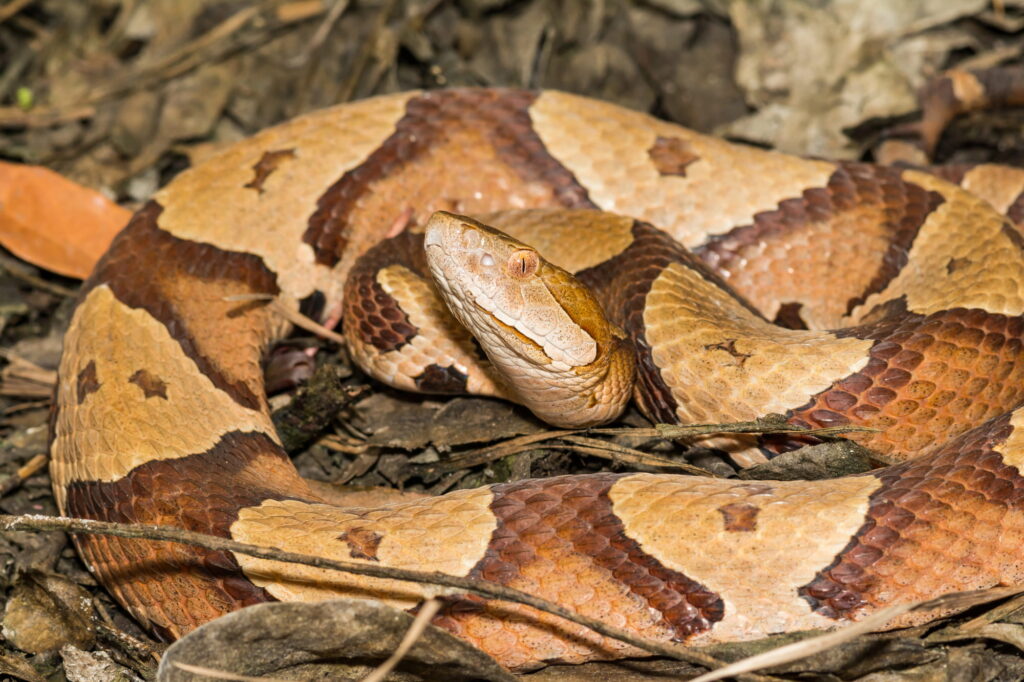
Eastern Copperhead snake
The copperhead is the venomous snake Marylanders are most likely to encounter. It lives in most of the state, including wooded suburbs in Baltimore, Harford, and Howard counties.
Look for a thick, tan to pinkish body crossed by darker bands shaped like hourglasses. The bands are wide on the snake’s sides and pinch narrow along the spine. The head is a solid coppery color with no markings. Young copperheads have a bright yellow or greenish tail tip.
Copperheads rely on camouflage. They often stay still in leaf litter, woodpiles, and stone walls, which is why most bites happen when someone reaches or steps without looking. They’re active during the day in spring and fall and shift to nighttime activity during hot summer stretches.
Timber Rattlesnake
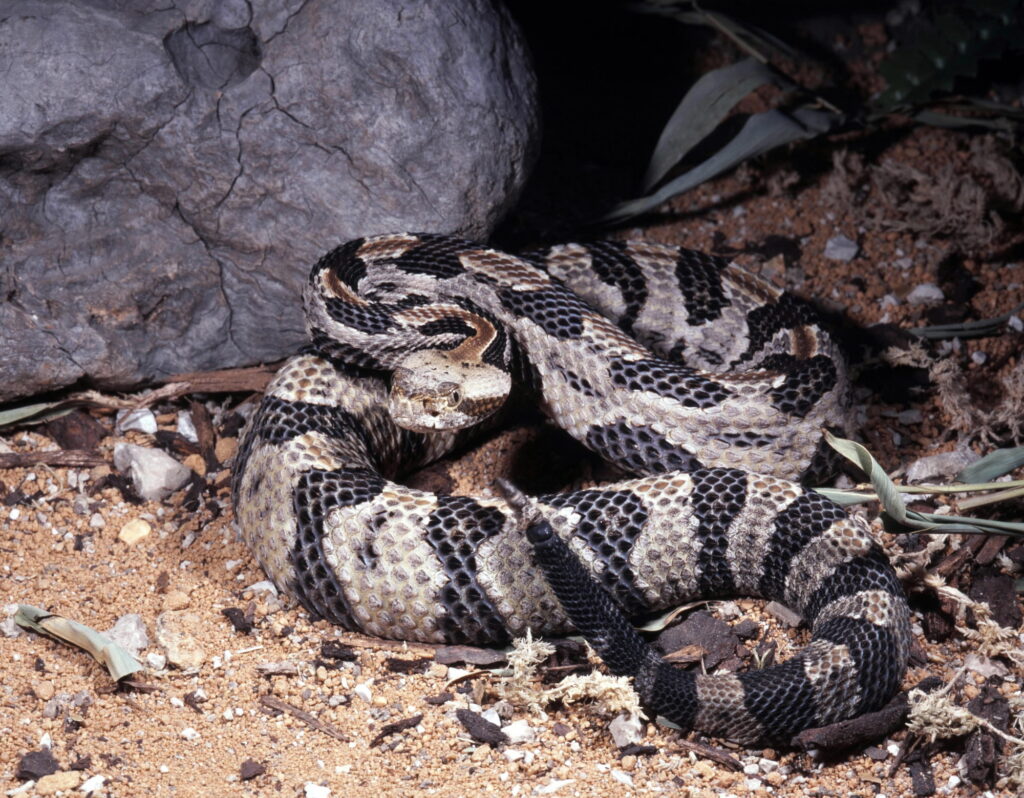
Timber Rattlesnake
Timber rattlesnakes are much rarer in Maryland and are concentrated in the mountains of Western Maryland, including Garrett, Allegany, Washington, and Frederick counties. If you live in the Baltimore area, you’re very unlikely to see one.
They’re heavy-bodied snakes with dark, jagged crossbands. Some are yellowish brown, and others are so dark they look nearly black. The tail ends in a black tip and a rattle. Timber rattlesnakes are generally reluctant to strike and will usually rattle or retreat first, but any bite needs emergency medical care right away.
Copperhead Lookalikes
Several harmless Maryland snakes get mistaken for copperheads every year. These are the most common ones.
- Juvenile Eastern Rat Snake. Young rat snakes are gray with dark blotches before they turn black. Their blotches look like saddles across the back rather than hourglasses, and their heads are narrower.
- Eastern Milk Snake. Its reddish-brown blotches are wide on the back and narrow on the sides, the reverse of a copperhead. Most milk snakes also have a light Y or V shape on the back of the neck.
- Northern Water Snake. Water snakes have dark bands near the neck that break into blotches farther down the body. They’re almost always near a stream, pond, or lake.
- Corn Snake. Corn snakes have orange or red blotches outlined in black and a black-and-white checkered belly. They’re less common in Maryland than the other species on this list.
If you can’t tell which one you’re looking at, treat it as venomous and keep your distance.
Are There Water Moccasins in Maryland?
No. Water moccasins, also called cottonmouths, are not found in Maryland. Their range ends in southeastern Virginia.
When someone in Maryland reports a water moccasin, it’s almost always a northern water snake. The confusion makes sense. Water snakes are thick, dark, and live in the same kinds of places people picture cottonmouths living. When cornered, they flatten their bodies, strike, and release a foul-smelling musk. That behavior is intimidating, but the bite is not venomous.
How to Tell a Water Snake From a Cottonmouth
These traits help if you’re near the Virginia line or traveling farther south.
- Swimming posture. Water snakes swim with most of the body below the surface. Cottonmouths float high, with much of the body riding on top of the water.
- Head shape. Cottonmouths have a blocky, wedge-shaped head and a heat-sensing pit between the eye and nostril. Water snakes have a narrower head with no pit.
- Defensive display. A cottonmouth opens its mouth wide to show the white lining. Water snakes bite and thrash instead.
Water Snakes in Maryland
Maryland has three snakes that spend most of their lives in or near water.
The northern water snake is the most common. Young ones have clear dark bands and blotches over a lighter brown base. Older snakes darken until the pattern is hard to see, especially when wet, which is why many people describe them as plain black or brown. The belly usually has reddish half-moon markings.
The plain-bellied water snake is found mainly on the Eastern Shore. Its back is a solid brown to black, and its belly is an unmarked orange-red.
The queen snake is smaller and more slender, with a yellow stripe running along each lower side. It lives along rocky streams and feeds almost entirely on crayfish.
Black Snakes in Maryland
“Black snake” covers several different species in Maryland. These are the ones you’re most likely to see.
Eastern Rat Snake
This is the snake most people mean when they say “black snake.” Rat snakes are Maryland’s largest snakes, commonly reaching 4 to 6 feet. They’re shiny black with a white or cream chin and throat, and a faint blotched pattern often shows between the scales when the snake stretches.
Rat snakes are excellent climbers. They turn up in barns, attics, sheds, and trees because that’s where rodents and birds’ nests are. They aren’t venomous and tend to freeze or coil up when approached. A frightened rat snake may vibrate its tail in dry leaves, which can sound a lot like a rattle.
Northern Black Racer
Racers are slimmer than rat snakes, with smooth, satiny scales and a white chin. The biggest difference is behavior. Racers move fast, hold their heads up while they hunt, and usually leave quickly when they spot a person. If cornered or handled, they’ll bite readily, though the bite is harmless.
Eastern Kingsnake
The eastern kingsnake is glossy black with thin white or yellowish bands that form a chain pattern. In Maryland, it’s found mostly in Southern Maryland and on the Eastern Shore. Kingsnakes eat other snakes, including copperheads, so they’re a welcome neighbor. If you searched for a “black and white” or “black and yellow” snake, this may be the one you saw.
Dark Timber Rattlesnakes
Some timber rattlesnakes are so dark they look black. In Western Maryland, check any heavy-bodied black snake for jagged bands and a rattle before getting closer.
Brown Snakes in Maryland
Most brown snakes in Maryland yards are small and harmless.
- Northern Brown Snake (DeKay’s Snake). Usually under a foot long, with two rows of small dark spots down the back. It hides under mulch, rocks, and landscape timbers and eats slugs and worms, which makes it useful in a garden.
- Red-Bellied Snake. Also under a foot long, brown or gray on top with a bright red or orange belly. It prefers wooded areas and leaf litter.
- Eastern Copperhead. The one brown snake to watch for. Check for the hourglass bands and solid copper head described above.
Green Snakes in Maryland
The rough green snake is the one most Marylanders see. It’s bright green, very thin, and can reach 3 feet. It spends most of its time in shrubs and low branches, often near water, where its color blends almost perfectly with the leaves.
The smooth green snake is much rarer here and is mostly limited to the western part of the state. It’s smaller and stays on the ground in grassy areas. Both species are harmless and eat insects and spiders.
Striped Snakes in Maryland
The eastern garter snake is one of the most common snakes in Maryland. It usually has three yellowish stripes running down a darker body, often with a checkered pattern between them. Garter snakes turn up in lawns, gardens, and around foundations.
The eastern ribbon snake looks similar but is thinner, with brighter stripes and a longer tail. It stays close to water and has a small white mark in front of each eye.
Other Small Snakes You May Find
A few more harmless species round out what Maryland homeowners commonly report.
- Ring-Necked Snake. Slate gray or black with a yellow-orange ring around the neck and an orange belly. Often found under rocks and logs.
- Eastern Hognose Snake. Recognizable by its upturned snout. When threatened, it flattens its neck, hisses, and may roll over and play dead. That performance leads many people to assume it’s dangerous, but it rarely bites.
- Eastern Worm Snake. Small, brown, and smooth, with a pink belly. It spends most of its time underground.
Why Snakes in Maryland End Up Around Your Home
Snakes go where food and shelter are. In most cases, a snake near your house means there’s a steady supply of mice, rats, insects, or frogs close by.
Common reasons snakes settle in around Maryland homes include:
- Rodent activity in garages, sheds, basements, or crawlspaces
- Gaps around the foundation, utility lines, dryer vents, or garage doors
- Woodpiles, rock piles, and stacked materials close to the house
- Tall grass and overgrown landscaping next to the foundation
Snakes in Maryland are active from about April through October. In early fall, they start looking for places to spend the winter, which is when many homeowners find them in basements and crawlspaces.
What to Do If You Find a Snake
Most snake bites happen when someone tries to catch, move, or kill the snake. Give it space and it will usually leave on its own. If it doesn’t, or if it’s inside your home, follow these steps.
- Keep children and pets away from the area.
- Stay at least several feet back and don’t try to handle the snake.
- Take a photo from a safe distance so it can be identified.
- If the snake is indoors, close off the room if you can safely do so.
- Call a professional wildlife removal company to remove it.
What to Do If You’re Bitten
If a snake bites you and you aren’t sure what kind it was, treat it as a venomous bite.
- Call 911 or get to an emergency room right away.
- Stay as calm and still as possible, and keep the bitten area roughly at heart level.
- Remove rings, watches, or tight clothing near the bite before swelling starts.
- Don’t cut the wound, try to suck out venom, apply ice, or use a tourniquet.
The Poison Help line at 1-800-222-1222 can also give guidance while you’re getting care. Copperhead bites are rarely fatal, but they’re painful and still need medical treatment.
This section is for general information only and is not medical advice. Always seek emergency care after a snake bite.
Maryland Snake FAQs
Are there rattlesnakes in Maryland?
Yes. The timber rattlesnake lives in Maryland, mostly in the mountains of Western Maryland. They’re rarely seen in the Baltimore area or central Maryland.
How many venomous snakes are in Maryland?
Two. The eastern copperhead and the timber rattlesnake are the only venomous snakes native to Maryland.
Are there water moccasins in Maryland?
No. The closest water moccasins live in southeastern Virginia. Snakes reported as water moccasins in Maryland are almost always northern water snakes.
What is the big black snake in Maryland?
It’s usually an eastern rat snake. Rat snakes can grow over 6 feet long and are not venomous. The northern black racer is the other common black snake in Maryland.
How many kinds of snakes live in Maryland?
Maryland has 27 native snake species. The rest of the list after the two venomous species are all harmless to people.
Have a Snake Problem in Maryland? Contact Shumaker Animal Control Today
A snake in the yard is usually nothing to worry about. But a snake in the basement, garage, or crawlspace is a different story, and it’s often a sign of a rodent problem that needs attention too.
Shumaker Animal Control has over 25 years of experience helping Maryland homeowners with wildlife problems. We provide snake removal in Maryland across Baltimore County, Baltimore City, Harford County, Anne Arundel County, Howard County, and Queen Anne’s County. Our team can identify the snake, remove it safely, and help you find and close the entry points that let it in.
Call us at (443) 854-8072 or fill out our contact form to speak with an animal removal expert.


